
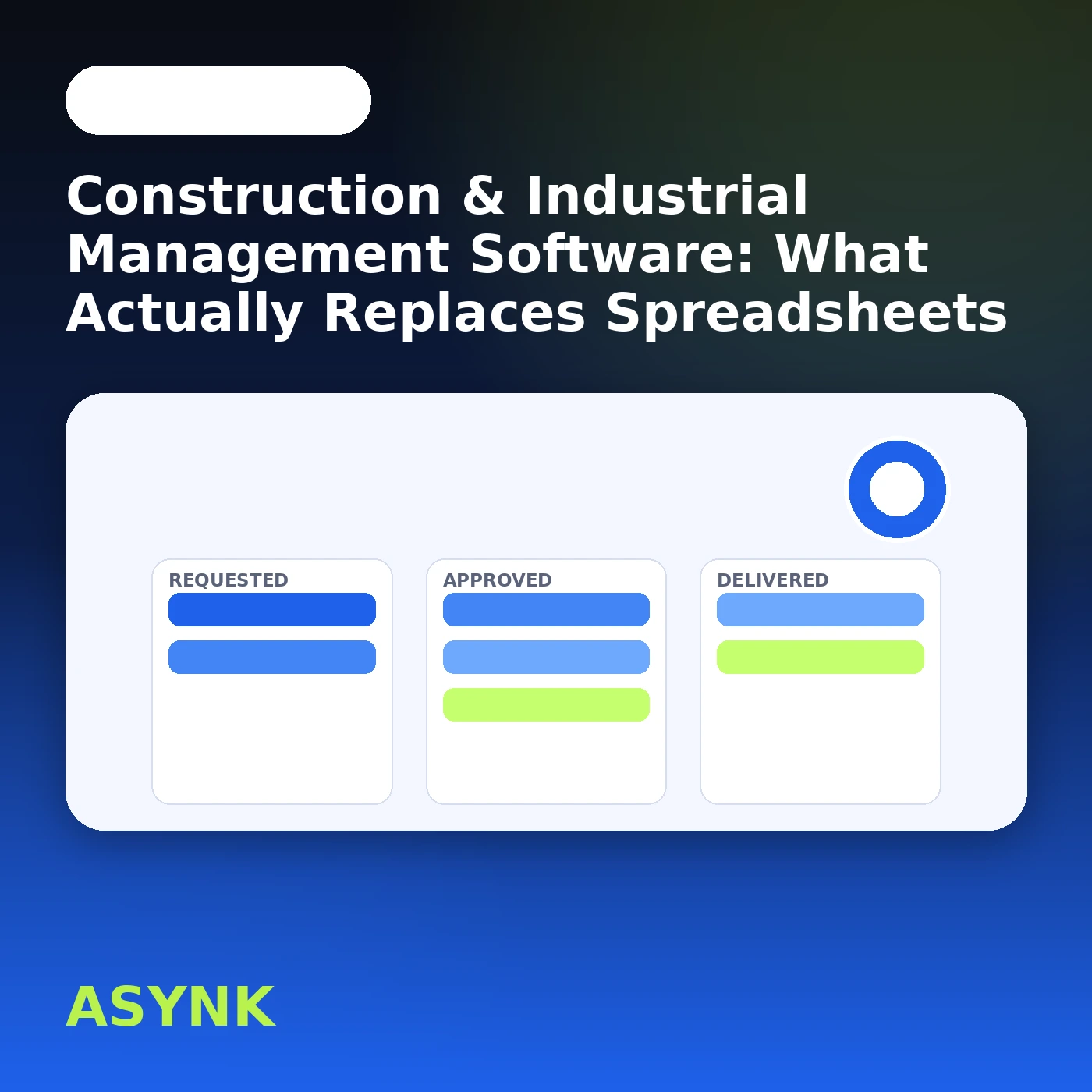
Construction & Industrial Management Software: What Actually Replaces Spreadsheets
Construction and industrial businesses tend to run on spreadsheets for longer than almost any other sector, not because spreadsheets are a good fit, but because the alternative usually looks like buying a rigid, generic ERP that assumes a factory floor rather than a live project site. The result is that most teams keep adding tabs, until procurement, site progress, inventory and inspections are each tracked in a different file, updated by a different person, and never fully in sync with each other.
That fragmentation, not the spreadsheet itself, is usually the real problem. A single spreadsheet works fine for a single project with a handful of vendors. It stops working once a business runs multiple sites at once, each with its own purchase requisitions, purchase orders, delivery challans, material inspections and stock movements, all of which need to reconcile against each other and against site progress.
Where spreadsheets actually break down
- Procurement traceability: a purchase requisition, its approval, the resulting purchase order, the vendor's delivery challan and the final material inspection all need to connect to one record. In separate spreadsheets, that chain breaks constantly.
- Vendor and quotation history: comparing vendor quotes and tracking performance over time is difficult once it depends on someone remembering which tab has the latest numbers.
- Site-level inventory: material issued to a site, returned, consumed or transferred between sites needs a running balance. Spreadsheet stock counts drift from reality within weeks.
- Inspection and quality records: Material Inspection Requests and Inspection & Test Requests need an approval trail, not a comment in a cell.
- Visibility for management: with data split across files, there is no single dashboard for procurement status, inventory position or project progress across sites.
What a real replacement looks like
The fix is not necessarily a large, generic ERP. For most construction and industrial businesses, the more useful shape is a connected system built around the actual workflow: projects and work orders at the centre, with procurement, vendors, inventory and quality records linked to them rather than living separately. When Asynk built a construction and enterprise management platform for Madhuram Enterprises, that was the starting point: connecting project dashboards, work orders, purchase requisitions, purchase orders, delivery challans, Material Inspection Requests, Inspection & Test Requests and warehouse or site-level inventory into one system rather than ten spreadsheets.
- Project and work-order tracking with progress, activity and quality records in one dashboard.
- Purchase Requisition and Purchase Order workflows with a visible approval history.
- Vendor, subcontractor and quotation management with performance history.
- Challan and material receipt records that reconcile against purchase orders automatically.
- Material Inspection Requests and Inspection & Test Requests with their own approval flow.
- Warehouse and site inventory covering issue, transfer, return and consumption, not just opening and closing stock.
It doesn't have to be built all at once
A common mistake is treating this as one large project that has to launch fully formed. In practice, procurement and vendor management can go live first, since that alone removes most of the traceability problem, with inventory and inspection modules following as a second phase. A connected system can also be scoped around field service and technician-facing workflows rather than construction procurement specifically. When Asynk built an inspection, service and AMC management CRM for Vacuum Drying Technology India, the same underlying idea applied: replacing spreadsheet-based scheduling and service history with a system where technician assignments, digital checklists, service reports and AMC renewals all live in one place with a clear approval trail.
How to scope it without overbuilding
- Start by mapping the actual approval chain your team follows today, not the one on paper, and digitise that first.
- Pick the one workflow causing the most rework or the most disputes, procurement, inventory or inspections, and build that module first.
- Keep the data model close to how your team already talks about work orders, sites and vendors, rather than forcing it into a generic ERP's vocabulary.
- Plan for mobile or field-facing access from the start if site staff, technicians or inspectors need to update records outside an office.
- Treat dashboards as a byproduct of good workflow design, not a separate reporting project bolted on afterward.
Related reading


Don't just take our word for it
Frequently asked questions
It can absolutely be phased. Most construction and industrial businesses get the most value by digitising procurement and vendor management first, since that is usually where the most reconciliation problems live, and adding inventory, inspection and reporting modules in later phases.

Ready to Build Software That Grows Your Business?
Partner with Asynk to build scalable websites, mobile apps, CRM solutions, and custom business software tailored to your goals. Book a free consultation with our development team and turn your idea into a reliable digital product.